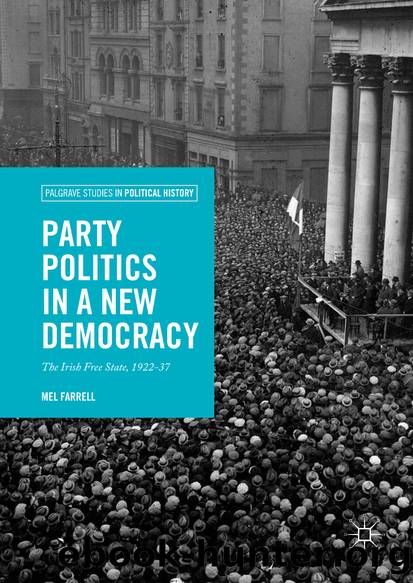
Party Politics in a New Democracy by Mel Farrell
Author:Mel Farrell
Language: eng
Format: epub
Publisher: Springer International Publishing, Cham
The June 1927 Election
As he addressed Fianna Fáil supporters in Mullingar on 1 January, de Valera honed his new partyâs message. Its approach would essentially wrap the traditional anti-Treaty position around Fianna Fáilâs new socio-economic policies. In Mullingar, de Valera attacked the office of the Governor-General of the Irish Free State, arguing that the cost to the taxpayer of maintaining its office was exorbitant. 46 In the general election campaign, Fianna Fáil developed popular policies that were critical of the salaries paid to officials, government ministers and the governor-general. Fianna Fáilâs organising committee planned the partyâs general election campaign, making arrangements for an âintensive campaign of public meetingsâ to cover the period from January to polling day. 47 In a scheme estimated to cost £700, the party planned to hire provincial organisers and to provide financial assistance for prominent local party workers. 48
Cumann na nGaedheal had been preparing for the election since late autumn 1926. Although it was now better organised than it had been in 1923, preparations for the election mirrored those of the previous contest. Cumann na nGaedheal again campaigned as the ânational partyâ and recruited a large number of paid organisers to breathe new life into the partyâs constituency structures. In Clare, local canvassers claimed that Cumann na nGaedheal was ânot simply a political organisationâ, it stood for the whole community: farmers, labourers, traders and professionals. 49 Those assembled for a Cumann na nGaedheal rally in Crusheen heard that the party was the only one capable of reconciling diverse interests and that Cosgraveâs ministers were working towards the common good. By 4 February 1927, the standing committee minutes recorded that the party had twenty-four organisers working in the constituencies. Fifteen of these organisers had been in place since November. 50 In his study of Free State politics, Warner Moss noted that these paid organisers were required to stir existing branches into action and to form new ones where there was poor organisation. 51 On 12 November, the standing committee discussed the timing of the general election. Most of those who were present indicated a preference for a post-budget election, in May or June 1927. Sub-committees were subsequently formed to raise funds for the party while overdrafts were secured from a number of banks. These measures brought the total Cumann na nGaedheal election fund to over £10,000. 52 Keen to avoid a repeat of the mistakes made during the 1923 election, when several local committees had incurred debts, the party made it clear that it was up to the local organisation to be responsible. Such local exuberance as displayed by the Clare constituency committee in 1923 was not unique to Cumann na nGaedheal. Some Fianna Fáil units came into financial difficulty in the late 1920s. In 1929, Fianna Fáil had to use the national collection to clear the Donegal organisationâs debts. 53 In 1927, Cumann na nGaedheal repeatedly reminded the organisation that each constituency should bear the brunt of its own election expenses. 54 This message was reiterated
Download
This site does not store any files on its server. We only index and link to content provided by other sites. Please contact the content providers to delete copyright contents if any and email us, we'll remove relevant links or contents immediately.
| Elections & Political Process | Ideologies & Doctrines |
| International & World Politics | Political Science |
| Public Affairs & Policy | Specific Topics |
| United States |
The Secret History by Donna Tartt(18974)
The Social Justice Warrior Handbook by Lisa De Pasquale(12172)
Thirteen Reasons Why by Jay Asher(8858)
This Is How You Lose Her by Junot Diaz(6845)
Weapons of Math Destruction by Cathy O'Neil(6231)
Zero to One by Peter Thiel(5743)
Beartown by Fredrik Backman(5691)
The Myth of the Strong Leader by Archie Brown(5474)
The Fire Next Time by James Baldwin(5398)
How Democracies Die by Steven Levitsky & Daniel Ziblatt(5185)
Promise Me, Dad by Joe Biden(5120)
Stone's Rules by Roger Stone(5060)
A Higher Loyalty: Truth, Lies, and Leadership by James Comey(4923)
100 Deadly Skills by Clint Emerson(4888)
Rise and Kill First by Ronen Bergman(4747)
Secrecy World by Jake Bernstein(4712)
The David Icke Guide to the Global Conspiracy (and how to end it) by David Icke(4664)
The Farm by Tom Rob Smith(4475)
The Doomsday Machine by Daniel Ellsberg(4463)
